Hydrophobic Interaction Chromatography
Separate proteins by surface hydrophobicity, binding at raised salt and eluting as salt decreases.
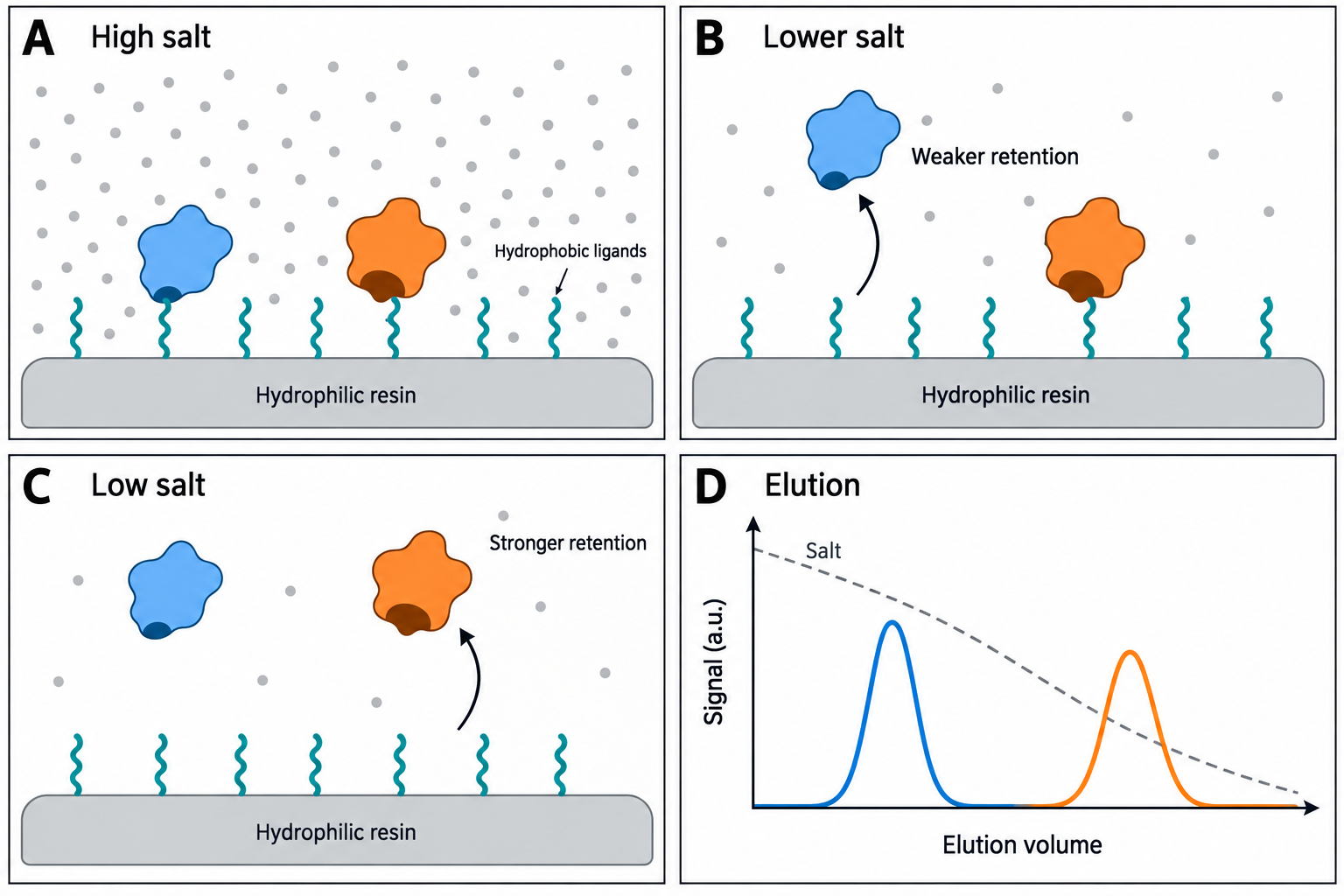
Principle
HIC resins carry hydrophobic ligands (for example phenyl, butyl, octyl) on a hydrophilic matrix. Strongly salting-out salts in the Hofmeister series, such as ammonium or sodium sulfate, promote interaction between exposed hydrophobic regions on the protein surface and the ligand, so proteins bind at raised salt. Decreasing the salt concentration weakens the interaction; less hydrophobic species elute first and more hydrophobic species elute later.
HIC runs in aqueous buffers and is described as relatively mild and less denaturing than reversed phase chromatography, which needs organic solvents for elution. That does not guarantee activity or structure for a given protein: high salt can cause precipitation, and strong binding or additives can cause inactivation. Check recovery and activity on the actual sample.
Salt selection and concentration
Ammonium sulfate is widely used. Cytiva™’s HIC handbook describes typical binding conditions around 1–2 M ammonium sulfate (or about 3 M NaCl) but treats salt type and concentration as empirical choices. Many proteins precipitate at raised salt, so first establish the salt range in which the target stays soluble and active, then scout for the lowest salt concentration that gives adequate binding and resolution.
Resin hydrophobicity
Retention depends on the ligand, the ligand density (degree of substitution), the matrix and the protein. Higher ligand density generally increases binding strength and capacity up to a point; if elution is difficult, a resin with the same ligand at lower density can help. Straight-chain alkyl ligands behave mainly hydrophobically, while phenyl ligands can also contribute aromatic interactions. Proteins with similar properties can behave quite differently on the same ligand, so select the resin by screening with the target rather than from a fixed ranking.
Gradient design
- Binding: load in start buffer at a salt concentration inside the target’s stability window.
- Elution: decreasing salt gradient; about 10–20 CV is a common scouting length, refined once the elution window is known.
- Additives and strip: alcohols, detergents or glycols can weaken strong binding, and harsher solutions may be needed to remove tightly bound material. Additives can inactivate or denature proteins; use the cleaning solutions listed for the exact resin.
Decreasing-salt gradient in HIC
Two illustrative proteins follow log k = log k0 + S·m, where m is the salt concentration and a larger S stands for a more hydrophobic contact. The dashed line shows outlet ammonium sulfate concentration in M. Salt decreases along the gradient, so retention weakens and the less hydrophobic protein elutes first.
- Protein 1 elutes at
- 0.4 M
- Protein 2 elutes at
- 0.35 M
- Elution volume 1
- 15 CV
- Elution volume 2
- 15.7 CV
- Resolution Rs
- 1.3
- Peak width 2 (4σ)
- 0.5 CV
Model: high-salt limit of the solvophobic retention equation (log k linear in salt molality; concentration in M used as a proxy), as summarised by Mahn (InTech book chapter); elution order and gradient trade-offs as in the Cytiva™ HIC handbook. Same zone-migration engine as the IEX simulator (V0 = 0.4 CV, equal-area Gaussian peaks, gradient band compression not applied). Parameters are illustrative; real salt effects depend on salt type, protein and resin, and precipitation limits are not modelled.
Sources and scope
Cytiva™, Hydrophobic Interaction and Reversed Phase Chromatography: Principles and Methods (official handbook, accessed 2026-09-25) supports the binding mechanism, salt effects, ligand and ligand-density effects, empirical resin selection and the precipitation caveat. Its example conditions are starting points, not universal recipes. Consult the exact resin instructions for salt, pH, pressure and cleaning limits.
The simulator uses the high-salt limit of the solvophobic retention equation, in which log k rises linearly with salt molality, as summarised in Mahn, Hydrophobic Interaction Chromatography: Fundamentals and Applications in Biomedical Engineering (InTech). Its parameters are illustrative; it is a teaching model, not a method prediction.
Try it on a trace
Open a two-column chromatogram in the workbench, or load the synthetic example. No account needed.
Open the workbench