Reversed Phase Chromatography
Hydrophobic LC for analytical separations of peptides and compatible analytes.
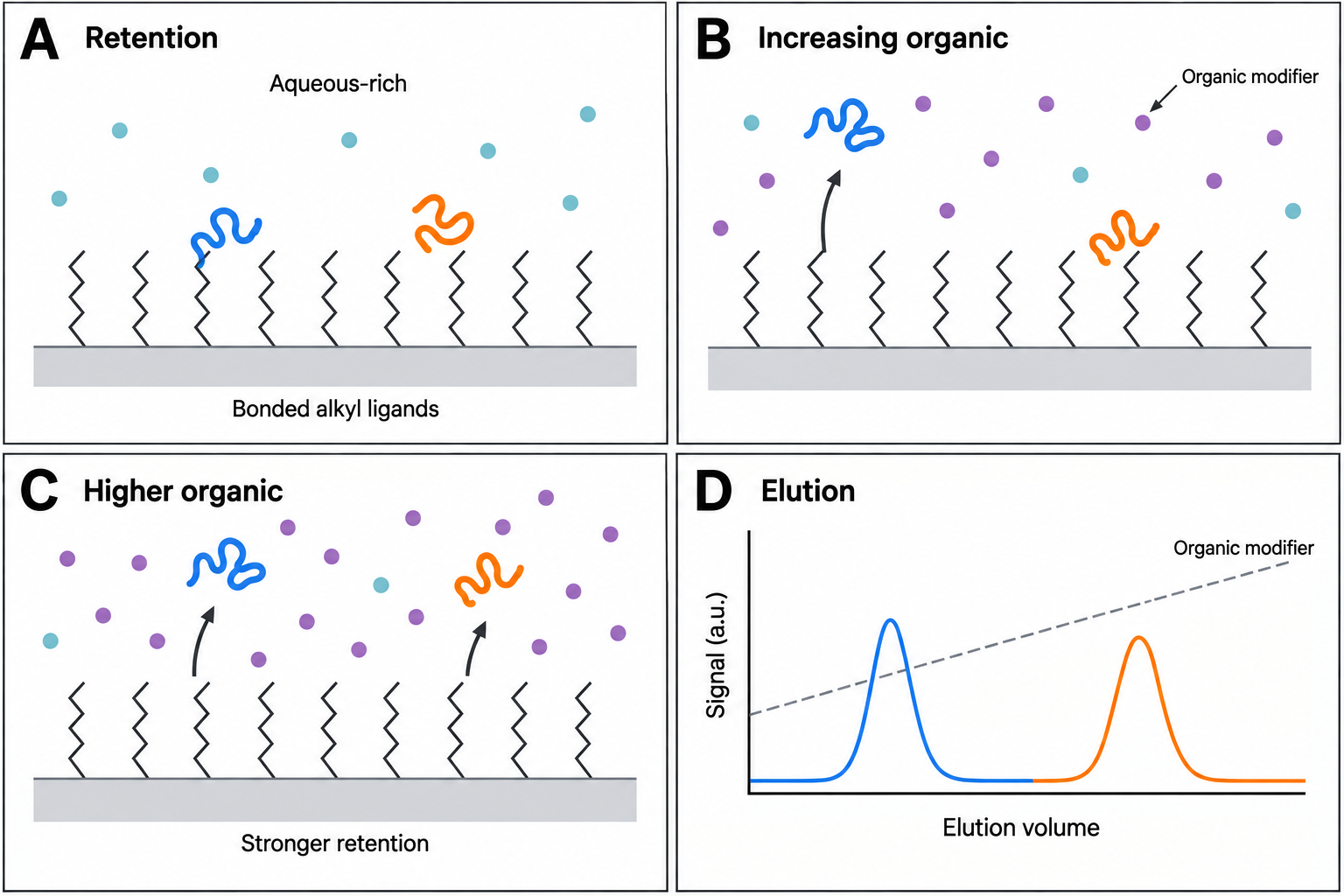
Principle
RPC resins present nonpolar alkyl chains (C4, C8, C18). Analytes bind by hydrophobic interaction in aqueous buffer and are eluted by increasing organic modifier concentration. Retention and recovery depend on stationary phase, pore structure, temperature, mobile phase, and analyte. C4, C8, and C18 are common choices, but no chain length is universally best for intact proteins or peptides.
Method development
Organic modifier, acid, temperature, gradient, and stationary phase must be selected and validated for the analyte and detector. Use the column and instrument manuals to set solvent compatibility and pressure limits; this page does not prescribe a universal mobile phase or gradient.
Applications
- Peptide mapping: RP separation can precede a suitably validated identification workflow; retention alone does not establish sequence or modification identity.
- Small molecules and peptides: RP can provide useful analytical or preparative separation when recovery and compatibility are demonstrated.
- Intact proteins or ADCs: use a fit-for-purpose, validated method and an appropriate detector/orthogonal assay for mass, truncation, or DAR questions. Chromatography alone does not confirm mass, sequence, or DAR.
Notes on protein RPC
RP conditions can denature proteins and reduce recovery, but the effect is analyte- and method-dependent. Establish structural integrity, activity, and recovery experimentally whenever they matter. HIC may be a useful alternative in some workflows, not a universal substitute; RP can be analytical or preparative for compatible analytes.
Sources and scope
Biopharmaceutical Analysis by HPLC: Practices and Challenges (secondary review; accessed 2026-09-25) supports RP-HPLC’s analytical uses and condition-dependent denaturation/recovery risks. The source does not justify universal C4/C18, solvent, or DAR prescriptions.
Try it on a trace
Open a two-column chromatogram in the workbench, or load the synthetic example. No account needed.
Open the workbench